
Theta Explained: The Change in An Options Price In Relation To Time Decay
What Are Option “Greeks?”
Greeks Overview:
While Delta tells you how much an Option's price changes with the underlying asset price, and Gamma tells you how fast Delta itself is changing, Theta tells you how much an option's price decreases simply with the passage of time. Understanding Theta is crucial for managing risk in time-sensitive positions, especially for traders holding long options or writing short premium strategies.
Option Greeks are mathematical measures that describe how different factors will affect the price of an Options contract. These factors include changes in the Underlying Asset's Price, Time to Expiry, Volatility, Interest Rates. The Greeks are essential for traders to understand the risks and potential rewards of options trading.
Theta Explained in Detail:
1. Theta (Θ): Sensitivity to the Passage of Time
What it Measures:
Theta (Θ) measures the rate of change in an Option's price with respect to the passage of one calendar day, all other factors remaining constant. It represents the daily erosion of an Option's time value as it moves closer to expiration. Theta is almost always expressed as a negative number for long options, representing the daily cost of holding that position.
Universal Theta Rule: For Long Calls and Long Puts, Theta is negative (time decay works against the buyer). For Short Calls and Short Puts, Theta is positive (time decay works in favour of the seller). Theta typically accelerates as an option approaches expiration, with At-The-Money (ATM) options experiencing the most rapid time decay in absolute terms.
Theta's formula differs slightly for Calls and Puts. Ranges: Expressed in currency units per day (e.g., -$0.05 means the Option loses $0.05 of value per day).
Why Theta is Important (See Charts):
1. Theta changes across different "Moneyness" (ITM / ATM / OTM) levels. ATM Options have the highest Theta because they possess the greatest amount of time value — there is still genuine uncertainty about whether the option will expire in-the-money. This means ATM options lose the most value each day as time passes.
2. Theta accelerates dramatically as expiration approaches. The rate of time decay is not linear — it is convex, meaning an Option loses value increasingly rapidly in its final weeks and especially its final days before expiry. This is sometimes called the "Theta cliff."
3. Theta's Positive or Negative sign is directly related to whether you are a buyer (Long) or seller (Short) of Options. Long Option holders pay Theta every day. Short Option sellers collect Theta every day, which is the primary income source for premium-selling strategies such as covered calls, cash-secured puts, iron condors, and credit spreads.
Overview of Theta for a Long Call:
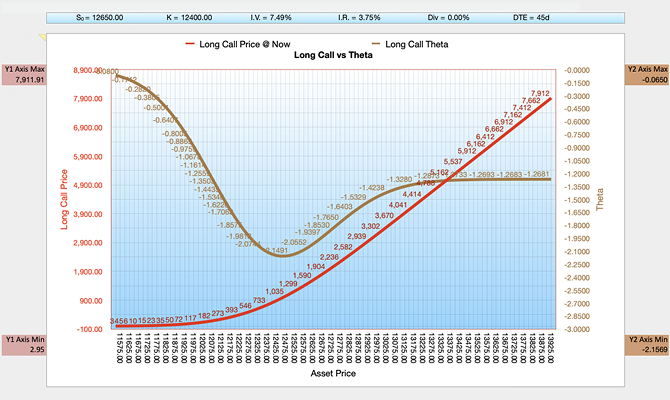
- Long Calls: Theta measures how much an 0ption's price decreases for every calendar day that passes, all else being equal. If the premium of a Long Call is $3.00 today, and Theta is -$0.05, then tomorrow the option will be worth approximately $2.95, purely due to time passing. Theta is typically quoted to 4 decimal places.
- For Long Options (Calls or Puts), Theta is always Negative, meaning time decay works against the buyer, eroding the Option's value daily regardless of what the underlying asset price does.
- The Negative sign for Long Call Option Theta reflects the fact that the buyer's position loses value simply by waiting. Every day that passes without a sufficiently large favourable move in the underlying asset reduces the Option's worth.
- Negative Long Theta indicates that the Option premium is steadily eroding. As the Option moves closer to expiry, this erosion accelerates, particularly for ATM options where all remaining value is time value with no intrinsic cushion.
- This creates a race against time: the Long Call buyer needs the underlying asset price to rise sufficiently fast to overcome the daily drag of Theta. The further OTM the option, the faster it will decay towards zero in proportional terms. Please refer to the Delta vs Theta chart below.
- Theta is highest in absolute terms when the Option is at-the-money (ATM) and decreases as the Option moves either deeper in-the-money (ITM), where intrinsic value dominates, or further out-of-the-money (OTM), where there is less time value left to decay.
- The goal for buying a Long Call Option is to risk the amount of premium paid (e.g., $100 paid by the Long Call holder means the maximum loss is limited to the cost of the option) and then, when the underlying asset price increases above the Strike price fast enough to outpace Theta decay, close the contract by selling the option for more, profiting from the difference.
Overview of Theta for a Short Call:
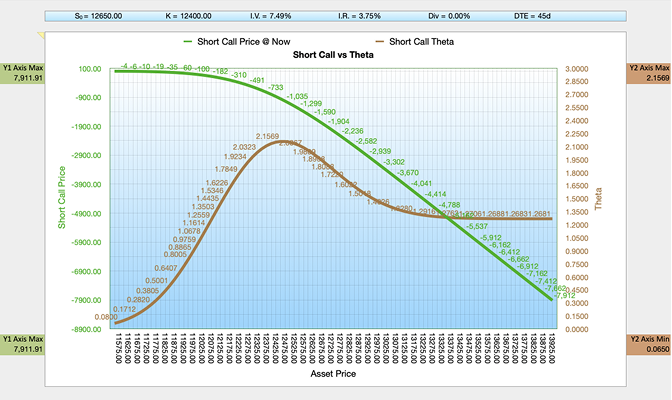
- Short Calls: Theta measures how much an Option's price decreases for every calendar day that passes, all else being equal. For the Short Call seller, this works in their favour — the option they sold is losing value each day, meaning they can buy it back for less than they sold it for. Theta is typically quoted to 4 decimal places.
- For Short Options (Calls or Puts), Theta is always Positive, meaning time decay works in favour of the seller. Every passing day adds to the seller's unrealised profit, assuming the underlying price does not move adversely.
- The Positive sign for Short Call Option Theta reflects the fact that the seller collects premium upfront and benefits as time erodes the Option's value. The seller's maximum profit is fully realised if the option expires worthless.
- Positive Short Theta indicates that the Short Call position gains value (for the seller) as each day passes. The closer the Option moves to expiry, the faster Theta works in the seller's favour, particularly if the underlying price remains below the Strike price.
- This creates a powerful income-generating dynamic: the Short Call seller earns daily Theta decay without needing the underlying price to move. Time alone is sufficient for the strategy to profit, provided the underlying price stays below the Strike price. Please refer to the Delta vs Theta chart below.
- Theta is highest in absolute terms when the Option is at-the-money (ATM) — meaning the seller earns the most time-decay income from an ATM short position — and decreases as the option moves ITM or OTM.
- The goal for Writing (selling) a Call Option is to collect the premium upfront (e.g., $100 received by the Short Call seller) and then hopefully close the contract by buying it back later for less, ideally $0 if the option expires worthless because the underlying price stayed below the Strike price.
Overview of Delta vs Theta for a Long Call:

- Explanation Why Theta is Highest ATM:
The Long Call Delta / Theta Relationship:
- (i) When the Underlying Asset Price Increases (ITM) :
- The Long Call Option moves further ITM, (above 12400).
- As the Option moves deeper ITM, Theta decreases (in absolute terms) because the Option's value is increasingly composed of intrinsic value rather than time value. Intrinsic value does not decay with time — only time value does.
- The deeper an Option moves ITM, the less time value remains to erode, so Theta decreases towards zero. A deeply ITM Option behaves more like the underlying asset itself, with minimal daily time decay.
- (ii) At-the-Money (ATM) (12400) :
- At the ATM level, the Option is entirely composed of time value — there is no intrinsic value. This is where Theta is at its maximum, because all of the Option's remaining value is subject to time decay.
- Theta is at its highest when the underlying price is near the strike price (ATM), because this is the point of maximum time value and therefore maximum daily erosion.
- (iii) When the Underlying Asset Price Decreases (OTM) :
- The Long Call Option moves further OTM, (below 12400).
- As the Option moves further OTM, Theta also decreases because the Option's total premium shrinks towards zero — there is progressively less time value left to decay. An OTM Option with very little premium has very little left to lose each day.
- For Long Calls (Bullish, Positive Delta) :
- Every day that passes → the Long Call loses time value (Theta) regardless of price movement. This is the primary headwind for all long Option buyers.
- If the underlying price rises → Delta increases (moves ITM) and gains in intrinsic value, potentially more than offsetting the daily Theta drag and resulting in a profitable position.
- Negative Theta causes daily erosion of the Long Call's time value. The buyer must generate sufficient Delta-driven profits to overcome this ongoing cost.
- Summary:
- Theta has a hump shape relative to the underlying asset price, peaking at ATM and declining as the Option moves ITM or OTM. Theta levels depend on how much time value remains in the option — which is greatest for ATM options.
Overview of Delta vs Theta for a Short Call:

- Explanation Why Theta is Highest ATM:
The Short Call Delta / Theta Relationship:
- (i) When the Underlying Asset Price Increases (ITM) :
- The Short Call option moves further ITM (above 12400), which is adverse for the seller.
- As Delta approaches -1 (deeply ITM), the negative Theta values decrease because the Option's value is increasingly intrinsic value, not time value. The seller now faces increasing losses driven by intrinsic value growth, rather than benefiting from time decay.
- This reduced Theta makes the Short Call position less dependent on time decay and increasingly exposed to Delta-driven losses as the underlying price rises.
- (ii) At-the-Money (ATM) (12400) :
- At the ATM level, the Short Call seller earns the maximum Theta — the daily erosion of time value is fastest here, working maximally in the seller's favour.
- Theta is at its highest when the underlying price is near the strike price (ATM), providing the greatest daily income to the Option seller from time decay alone.
- (iii) When the Underlying Asset Price Decreases (OTM) :
- The Short Call Option moves further OTM (below 12400), which is favourable for the seller.
- As the Option moves further OTM, Theta decreases because the Option's total remaining premium shrinks. The seller's daily income from time decay diminishes as the Option approaches zero value.
- For Short Calls (Bearish, Negative Delta) :
- Every day that passes → the Short Call gains in value to the seller (positive Theta income) as the Option's time value erodes, provided the underlying price stays below the Strike price.
- If the underlying price rises → Delta risk increases (moves ITM), which can overcome and reverse the Theta income, resulting in a loss for the seller. This is the key risk of short Options.
- Positive Theta causes daily income accumulation for the Short Call seller. The seller must ensure Delta risk does not overwhelm this Theta income from adverse price moves in the underlying.
- Summary:
- Theta has a hump shape relative to the underlying asset price, peaking at ATM and declining as the Option moves ITM or OTM. Theta levels depend on how much time value remains in the Option — which is greatest for ATM Options.
Overview of Theta for a Long Put:
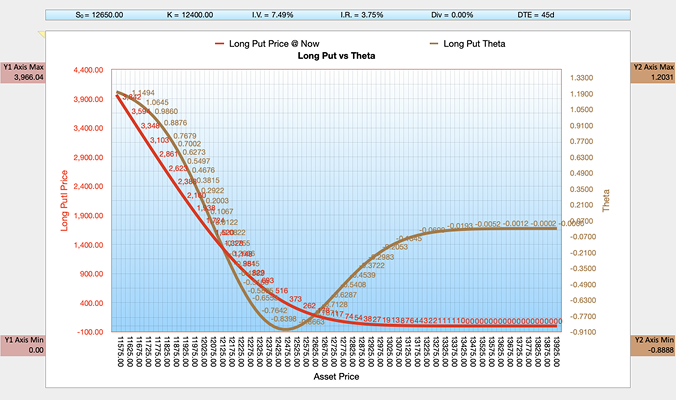
Overview of Delta vs Theta for a Long Put:

The Long Put Delta / Theta Relationship:
- Explanation Why Theta is Highest ATM:
- (i) When the Underlying Asset Price Increases (OTM) :
- The Long Put Option moves further OTM (above 12400).
- As the Option moves further OTM, Theta decreases in absolute terms because the total Option premium declines towards zero. With less total premium remaining, there is less time value available to erode each day, so the absolute daily Theta loss diminishes.
- The deeper an Option moves OTM, the lower the absolute Theta because the Option is approaching zero total value — there is simply less left to decay each day.
- (ii) At-the-Money (ATM) (12400) :
- At the ATM level, the Long Put Option is composed entirely of time value — there is no intrinsic value. This is where Theta is at its maximum because all remaining value is susceptible to daily erosion.
- Theta is at its highest when the underlying price is near the strike price (ATM), because this is the point of maximum time value and therefore maximum daily time decay.
- (iii) When the Underlying Asset Price Decreases (ITM) :
- The Long Put Option moves further ITM (below 12400). As the Option moves further ITM, Theta decreases because the Option's value becomes increasingly composed of intrinsic value, which does not decay with time — only the time value component decays.
- For Long Puts (Bearish, Negative Delta) :
- Every day that passes → the Long Put loses time value (negative Theta) regardless of price movement. This is the ongoing cost of the long Option position.
- If the underlying price falls → Delta becomes more negative (moves ITM), generating intrinsic value gains that can more than offset the daily Theta cost, resulting in a profitable trade.
- Negative Theta causes daily erosion of the Long Put's time value. The buyer must generate sufficient Delta-driven intrinsic value gains to overcome this ongoing cost before expiry.
- Summary:
- Theta has a hump shape relative to the underlying asset price, peaking at ATM and declining as the Option moves ITM or OTM. Theta levels depend on how much time value remains in the Option.
Overview of Theta for a Short Put:
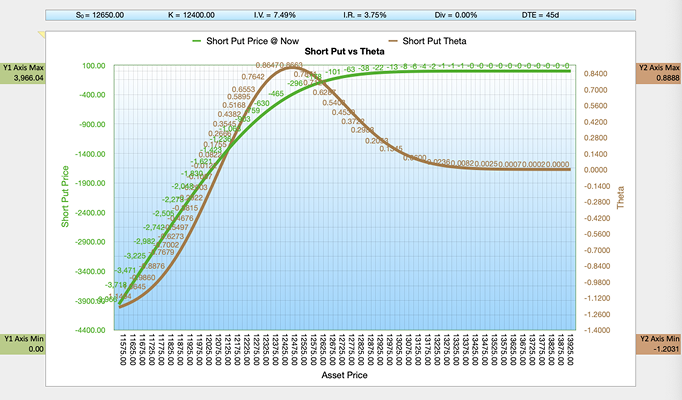
Overview of Delta vs Theta for a Short Put:

The Short Put Delta / Theta Relationship:
- Explanation Why Theta is Highest ATM:
- (i) When the Underlying Asset Price Increases (OTM) :
- The Short Put Option moves further OTM (above 12400) — this is a favourable direction for the seller.
- As the Option moves further OTM, Theta decreases in absolute terms because the total Option premium declines. The daily income from time decay diminishes as the Option approaches zero value. The seller profits from this direction but earns less Theta income as the premium erodes.
- The deeper an Option moves OTM, the lower the absolute Theta and the less daily income the seller earns from time decay, though the position becomes progressively less risky.
- (ii) At-the-Money (ATM) (12400) :
- At the ATM level, the Short Put seller earns the maximum Theta income. This is where all Option value is time value, and therefore where the daily decay is fastest and most beneficial to the seller.
- Theta is at its highest when the underlying price is near the strike price (ATM), providing the greatest daily income to the Option seller from time decay alone.
- (iii) When the Underlying Asset Price Decreases (ITM) :
- The Short Put Option moves further ITM (below 12400) — this is an adverse direction for the seller. As the Option moves further ITM, Theta decreases because the Option's value is increasingly intrinsic value. The seller now faces mounting intrinsic value losses that overwhelm the daily Theta income.
- For Short Puts (Bullish, Positive Delta) :
- Every day that passes → the Short Put gains in value to the seller (positive Theta income) as the Option's time value erodes, provided the underlying price stays above the Strike price.
- If the underlying price falls → Delta risk increases (Option moves ITM), which can overcome and reverse the Theta income. This is the key risk of short Options — a large adverse move can destroy accumulated Theta gains rapidly.
- Positive Theta causes daily income accumulation for the Short Put seller. The seller must ensure Delta risk does not overwhelm this Theta income from adverse price moves in the underlying asset.
- Summary:
- Theta has a hump shape relative to the underlying asset price, peaking at ATM and declining as the Option moves ITM or OTM. Theta levels depend on how much time value remains in the Option — greatest for ATM options.
Overview — Theta for a Long Call & Long Put vs 7 Different Days to Expiry:
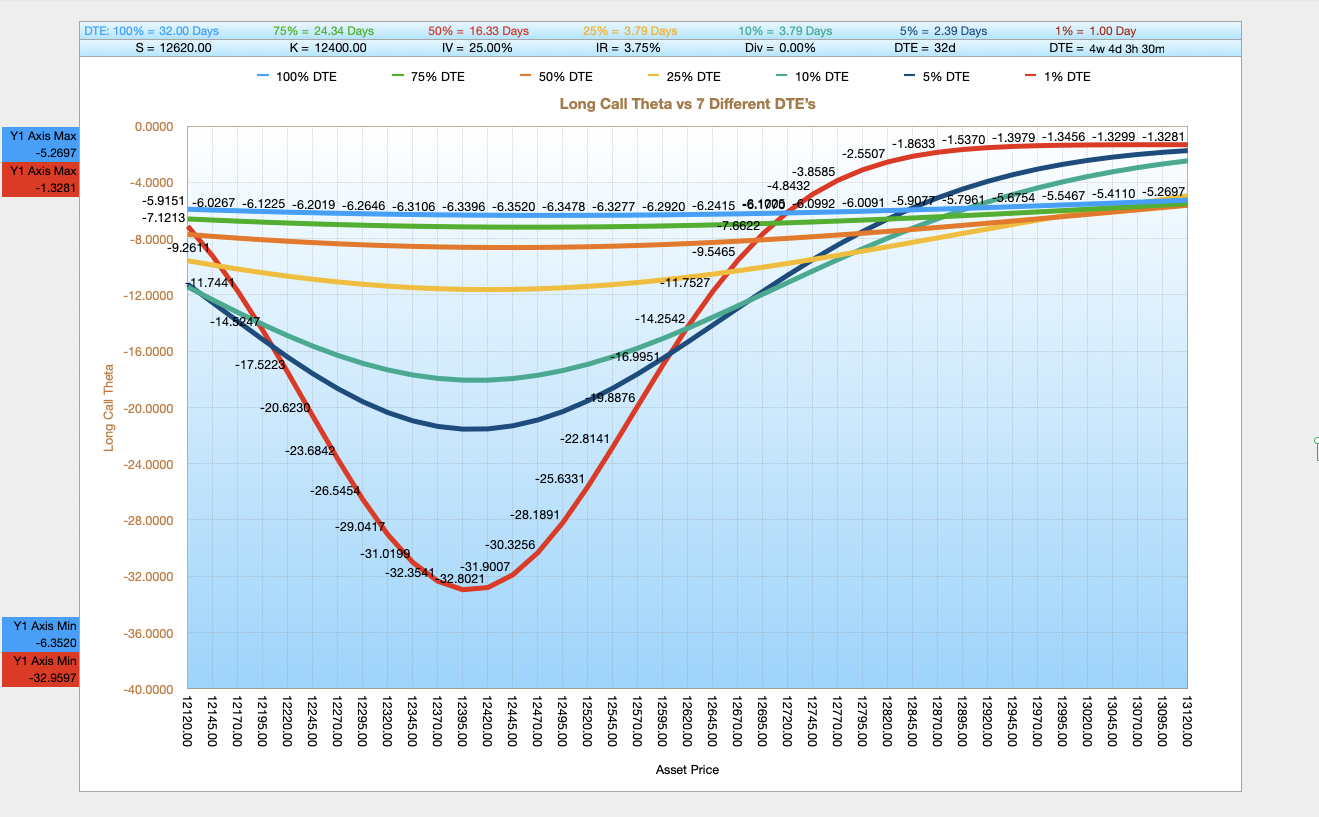
Theta's Time to Expiration (Days to Expiry) Relationship for a Long Call & Long Put
- (i) Near Expiration: (Note: The slope direction of the curves for a Long Put are the same as the Long Call).
- Theta becomes dramatically more negative (steeper decay) for ATM Options as expiration approaches. They have the maximum amount of uncertainty because it's unclear if they will finish with value or at zero. This creates rapid and accelerating daily value loss for Long Call and Put holders. Refer to the steep curve on the chart above.
- ITM and OTM Options experience diminishing absolute Theta as their time value is largely already priced out or replaced by intrinsic value - reducing the amount of Theta decay of the Option.
- (ii) Far from Expiration:
- Theta is relatively small and changes slowly for long-dated Options. The daily decay is gradual and spread more evenly across time. Refer to the relatively flat pale curve on the chart above.
Why is Option Theta Risk Much Higher for Short-Dated Options?
Theta measures the daily erosion of an Option's time value. For short-dated Options — those with very little time to expiration (DTE) — Theta is typically much higher in absolute terms because:
- (i) Time Compression Effect:
- As an Option approaches expiration, the remaining time value must decay to zero within an increasingly short window. The same total amount of time value is compressed into fewer remaining days, so each day's share of that decay is proportionally much larger.
- For an ATM Option with 1 day to expiry, virtually all remaining value must decay by tomorrow — making Theta extremely high.
- Reduced Time Value Pool: Short-dated ATM Options have time value that is concentrated and about to disappear entirely, making them extremely sensitive to the passage of each day.
- (ii) Mathematical Perspective:
- Theta accelerates non-linearly as expiration approaches. This is because the square root of time appears in the Black-Scholes formula — the rate of time value decay is proportional to 1/√T, which grows rapidly as T approaches zero.
- For an ATM Option with just days or hours remaining, even a small passage of time causes a disproportionately large reduction in value.
- The Option approaches a binary outcome — expire worthless or with intrinsic value — and the daily decay reflects this.
- The time value can swing from meaningful to near-zero with just a few days of passage near expiry.
- Example:
- A long-dated ATM Option with 180 DTE might have a Theta of -$0.03 per day.
- The same ATM Option with just 5 days to expiration might have a Theta of -$0.25 per day.
- This means daily value loss accelerates enormously for the long Option buyer as expiry approaches.
- For Options traders, high Theta near expiry represents both opportunity and risk:
- Opportunity: Short Option sellers can earn rapid Theta income in the final days of an Option's life.
- Risk: Long Option buyers face severe and accelerating time value erosion, needing a large, fast price move to overcome the Theta cliff.
- Practical implication: Traders holding long short-dated 0ptions must be extremely mindful of time passing, as even a stationary underlying price will cause significant daily losses. This is why many experienced option buyers prefer to buy options with 30–60 DTE or more, rolling before the Theta cliff steepens dramatically.
- This is why risk management is crucial when holding short-dated long Options — the Theta cost becomes a rapidly increasing drag that can overwhelm the position's Delta-driven profit potential.
Practical Implications for Traders:
- 1. Opportunity:
- Short-dated ATM short Options offer potential for rapid Theta income accumulation, which can be a primary income source in calm or range-bound market conditions.
- 2. Risk:
- Short-dated long Options carry heightened Theta risk because each passing day erodes value rapidly, requiring large and fast price movements to remain profitable.
- Traders must monitor positions closely, especially for ATM Options near expiry, where daily Theta loss is greatest.
- 3. Theta-Gamma Trade-Off:
- Theta and Gamma are inversely related — positions with high Gamma (long ATM short-dated Options) also carry the highest Theta cost. Positions with high positive Theta (short ATM short-dated Options) are exposed to the highest Gamma risk. This Theta-Gamma trade-off is one of the most fundamental relationships in Options trading.
Overview — Theta for a Short Call & SHort Put vs 7 Different Days to Expiry:
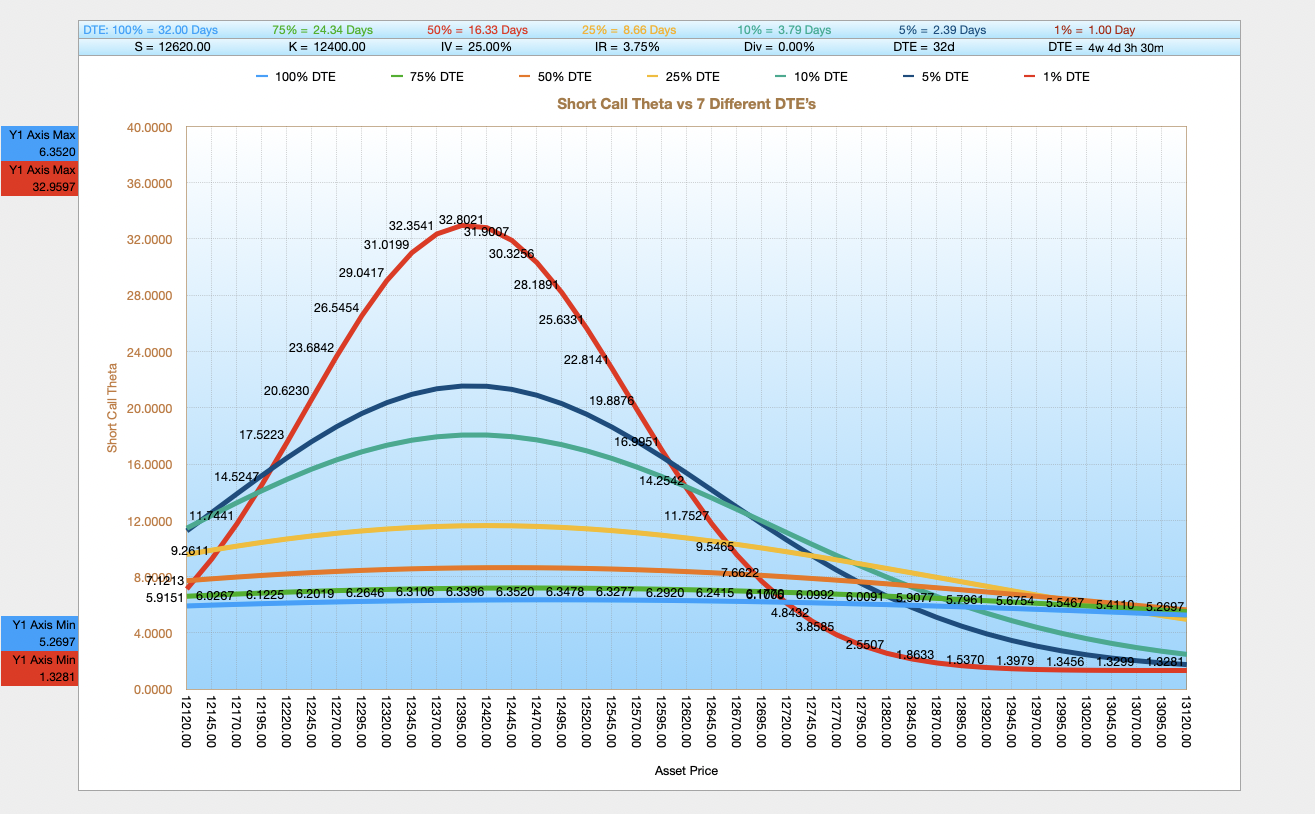
Theta's Time to Expiration (Days to Expiry) Relationship for a Short Call & Short Put
- (i) Near Expiration: (Note: The slope direction of the curves for a Short Put are the same as the Short Call).
- Theta becomes dramatically more positive (faster income) for ATM Short Call and Short Put positions as expiration approaches. This creates rapid and accelerating daily Theta income for the short seller in the final days before expiry. Refer to the steep curve on the chart above.
- ITM and OTM Options experience diminishing absolute Theta as their time value is largely already priced out or replaced by intrinsic value — reducing the daily income earned by the short seller.
- (ii) Far from Expiration:
- Theta is relatively small and changes slowly for short positions that are far from expiry. The daily income from time decay is gradual and spread more evenly across time. Refer to the relatively flat pale curve on the chart above.
Why is Theta Income Much Higher for High Implied Volatility Options?
- (i) High I.V. means inflated Premiums:
- Definition: High implied volatility (IV) reflects the market's expectation of larger price movements in the underlying asset, which inflates Option premiums.
- Effect on Theta: Because premiums are larger, there is more total time value to erode each day. This means Theta — the daily rate of time value decay — is also larger in absolute dollar terms.
- Why It Matters: Selling Options in high-IV environments is often referred to as "selling expensive Options" — the Theta income is maximised but so is the risk from large adverse price moves.
- (ii) IV Mean Reversion and Theta:
- Definition: IV tends to mean-revert — spikes in IV are typically followed by a decline back toward historical averages. This benefits short Option sellers doubly: they collect high Theta income AND benefit from a decline in IV (which reduces option prices via Vega).
- Effect on Short Sellers: Selling Options after an IV spike can be a highly profitable strategy, earning both Theta decay and a Vega-driven reduction in the Option's value simultaneously.
- Result: Timing short Option sales to coincide with elevated IV periods maximises both Theta income and the probability of a favourable IV mean-reversion working in the seller's favour.
- (iii) Greater Total Time Value in High-IV Options:
- Definition: High-IV Options contain substantially more time value than the same strike in a low-IV environment, because the market prices in more potential movement before expiry.
- Effect on Theta: A larger time value pool means more daily erosion — all else equal, Theta scales approximately proportionally with IV levels. Doubling IV roughly doubles the premium and thus the daily Theta income for short sellers.
- Example: A high-IV ATM short Option might earn $0.20 per day in Theta. The same Option in a low-IV environment might only earn $0.05 per day — a fourfold difference in daily income.
- (iv) Mathematical Perspective:
- Theta Behaviour in High IV: Because Black-Scholes Option pricing is directly proportional to IV (through Vega), higher IV produces higher premiums and therefore higher Theta in absolute terms. Theta and Vega are positively correlated.
- Implication: For high-IV Options, the rapid daily time value decay caused by Theta is much more pronounced in dollar terms, creating both higher income opportunities for sellers and higher daily cost burdens for buyers.
- Example:
- Imagine two ATM Put Options with identical parameters except for IV:
- Low-IV Option: Premium = $1.00, Theta = -$0.02/day. A manageable daily cost for the buyer; modest daily income for the seller.
- High-IV Option: Premium = $4.00, Theta = -$0.08/day. A significant daily cost for the buyer; attractive daily income for the seller — but with commensurately higher risk from potential large price moves.
Why Theta Risk Management is Crucial:
- High-IV Options may appear attractive for selling due to elevated Theta income, but they also carry elevated Delta and Gamma risks from the same large price moves the market is pricing in. Theta's seemingly steady income can be rapidly overwhelmed by a single adverse price move.
- This is why traders dealing with high-implied volatility Options must carefully account for the relationship between Theta income and the elevated risk of large underlying price movements. Collecting Theta in a high-IV environment requires robust risk management to ensure a single adverse event does not exceed all accumulated Theta gains.
Daily Theta Decay — Long & Short Positions:
Long Position Examples: Daily Theta Cost (Time Decay Working Against You)
| Position | Money- ness |
Option Premium | Theta (per day) | Effect on Premium After 1 Day | Effect on Premium After 7 Days | P&L After 7 Days |
|---|---|---|---|---|---|---|
| Long Call | ITM | $5.8000 | -$0.0220 | $5.7780 | $5.6460 | -$0.1540 Loss |
| Long Call | ATM | $3.0000 | -$0.0500 | $2.9500 | $2.6500 | -$0.3500 Loss |
| Long Call | OTM | $1.2000 | -$0.0280 | $1.1720 | $1.0040 | -$0.1960 Loss |
| Long Put | ITM | $5.5000 | -$0.0210 | $5.4790 | $5.3530 | -$0.1470 Loss |
| Long Put | ATM | $2.8000 | -$0.0480 | $2.7520 | $2.4640 | -$0.3360 Loss |
| Long Put | OTM | $1.1000 | -$0.0260 | $1.0740 | $0.9180 | -$0.1820 Loss |
Note: Theta is highest (most negative) for ATM long Options where all value is time value. ITM options carry significant intrinsic value which does not decay, so Theta is lower. OTM Options have little premium remaining, so absolute daily decay is also lower — but the proportional daily loss as a percentage of total premium can be severe.
Short Position Examples: Daily Theta Income (Time Decay Working For You)
| Position | Money- ness |
Premium Collected | Theta (per day) | Effect on Premium After 1 Day | Effect on Premium After 7 Day | P&L After 7 Days |
|---|---|---|---|---|---|---|
| Short Call | ITM | $5.8000 | +$0.0220 | $5.7780 | $5.6460 | +$0.1540 Profit |
| Short Call | ATM | $3.0000 | +$0.0500 | $2.9500 | $2.6500 | +$0.3500 Profit |
| Short Call | OTM | $1.2000 | +$0.0280 | $1.1720 | $1.0040 | +$0.1960 Profit |
| Short Put | ITM | $5.5000 | +$0.0210 | $5.4790 | $5.3530 | +$0.1470 Profit |
| Short Put | ATM | $2.8000 | +$0.0480 | $2.7520 | $2.4640 | +$0.3360 Profit |
| Short Put | OTM | $1.1000 | +$0.0260 | $1.0740 | $0.9180 | +$0.1820 Profit |
Note: Theta income is highest for ATM short Options. ITM short options earn less daily Theta but carry significant intrinsic value Delta risk. OTM short Options are lower risk but also generate less daily income — the buy-back cost is already low and approaching zero. The seller's profit is the difference between the premium collected and the buy-back cost.
Master Gamma and All the Option Greeks with the Single Option Pricer and Greek Charts Calculator.
Visualise Delta, Gamma, Theta, Vega and Rho in real time across all four Option positions — Long Call, Short Call, Long Put and Short Put. Model different scenarios and watch Gamma respond instantly to changes in DTE, IV, and underlying price.
Trade Like a Professional — Gain Confidence with Data-Driven Decisions to Maximise Profits and Minimise Risk.
Click the "Buy Now" Button and Download the BSM Option Pricer with Greek Charts Today. Available in both Excel and Apple Numbers:
Best of Luck in Your Options Trading,
Ian,
B.Sc. Finance (Hons), UWIST, Wales.
Related Black-Scholes-Merton Options Calculators:
Black-Scholes-Merton 10x Leg Option P & L Master Strategiser
Black-Scholes-Merton Greeks Calculator with Single Option Pricer
Black-Scholes-Merton Options Pricing Calculators (30x Banks)
Black-Scholes-Merton Implied Volatility Calculators (10x Banks)